
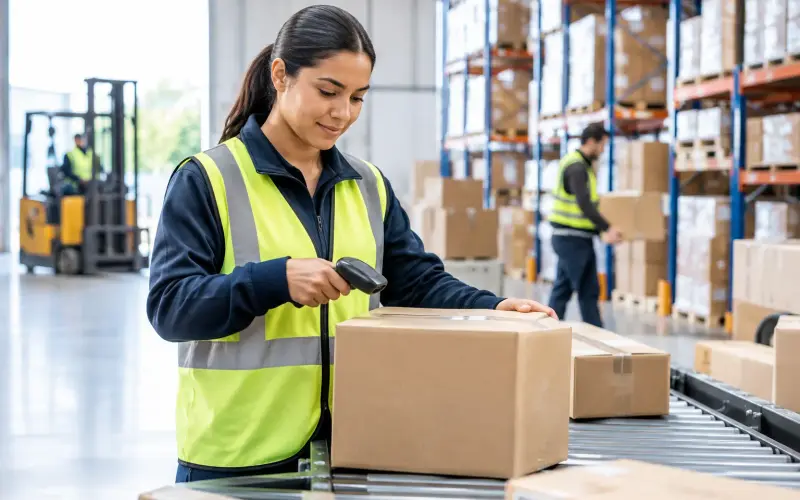
A delayed order rarely starts at the customer’s doorstep. It often begins with one misplaced carton, an unclear stock record or a picking route that wastes a few minutes dozens of times a day. Effective warehouse logistics prevents these small problems from becoming missed delivery promises, unnecessary costs and frustrated customers.
For businesses importing goods into Hungary, fulfilling webshop orders or distributing stock across Europe, the warehouse is more than a place to keep products. It is an active part of the supply chain. Goods need to arrive safely, be counted correctly, stored sensibly, selected quickly and dispatched with the right paperwork. When each stage works together, customers receive the right products on time and the business has a clearer view of its stock and costs.
What warehouse logistics covers
Warehouse logistics is the planning and day-to-day control of how goods move into, through and out of a warehouse. It connects inbound deliveries, storage, inventory control, order picking, packing, dispatch and returns.
The exact set-up depends on the business. A furniture importer may need space for palletised goods and careful handling of bulky items. A cosmetics webshop may need accurate piece picking, batch control and fast parcel dispatch. A company relocating office equipment may need temporary secure storage, condition records and timed deliveries to a new site.
The principle is the same: every item should have a known location, a clear status and an efficient route to its next destination.
The journey of stock through a warehouse
Receiving starts with checking, not storing
Good warehouse logistics begins before goods reach the racking. The warehouse should know what is due to arrive, in what quantity, from which supplier and whether any special handling is needed. Booking delivery times helps avoid congestion at the loading area and allows staff to prepare the right equipment and space.
When a shipment arrives, staff should check the number of pallets, cartons or parcels against the delivery documents. Visible damage, shortages and incorrect items need to be recorded immediately. This is particularly important for international freight, where a late discrepancy report can make a claim much harder to resolve.
For goods with batch numbers, expiry dates or serial numbers, those details should be captured at receipt. It may feel slower at first, but it prevents serious problems later, especially in sectors where traceability matters.
Put-away determines future speed
Put-away is the process of moving received goods to their storage location. It should follow a clear logic rather than relying on whichever space appears empty. Fast-moving products belong in accessible picking locations. Heavy goods need safe lower-level storage. Fragile, high-value or temperature-sensitive items may require separate areas and additional controls.
A simple location system can be highly effective. Each aisle, bay, shelf and pallet position should have a unique reference, and the reference must match the inventory record. Without this discipline, staff spend time searching and stock accuracy falls quickly.
There is also a trade-off. Using every available space can maximise capacity, but an overcrowded warehouse makes picking slower and increases the risk of damage. The most efficient layout balances storage density with safe, practical access.
Inventory accuracy protects customer trust
Stock records influence purchasing, sales, fulfilment and customer communication. If a website shows an item as available when it is not physically in the warehouse, the business may have to cancel an order or delay dispatch. Neither outcome builds confidence.
Regular cycle counts are usually more practical than a single annual stocktake. Instead of closing operations to count everything at once, staff count selected locations or products throughout the year. Fast-moving and high-value items should be checked more often than slow-moving stock.
Inventory control should also account for stock that is damaged, quarantined, reserved for an order or awaiting return inspection. Treating all stock as simply “available” creates avoidable errors.
Picking and packing: where accuracy meets speed
Order picking is often the most labour-intensive warehouse activity. Even a well-organised warehouse can lose money if pickers walk long distances, receive unclear instructions or repeatedly correct mistakes.
The right picking method depends on order volume and product range. Single-order picking can work well for lower volumes or complex orders. Batch picking, where one person collects items for several orders at once, can reduce walking time when many orders contain similar products. Zone picking can suit larger operations, with staff responsible for a particular part of the warehouse.
Before changing the process, measure the current situation. Look at picks per hour, order accuracy, average walking distance and the number of orders that need rework. A more sophisticated method is not automatically better if it adds complexity without solving a real bottleneck.
Packing is equally important. The aim is to protect the item while avoiding unnecessary material and excess parcel size. Oversized cartons increase transport costs, while inadequate protection creates breakage and claims. For international shipments, packaging must also withstand multiple handling points, longer transit times and possible customs inspection.
A consistent packing process should confirm the item, quantity, delivery address and any required documents before the parcel is sealed. For fragile goods, fine art, machinery or other specialist items, professional packing materials and techniques are essential rather than optional.
Dispatch and transport planning
Dispatch is the handover point between warehouse operations and transport. If orders are ready too late, even the best courier or freight service cannot meet the promised delivery date. Clear carrier collection times and realistic cut-off times help teams prioritise work throughout the day.
For domestic parcel deliveries, speed and tracking may be the main priorities. For European road freight, consolidation and delivery slots can have a greater effect on cost. For global air or sea freight, export documentation, customs requirements, cargo dimensions and transit time need to be planned well in advance.
A dispatch check should confirm that labels are legible, addresses are complete, weights and dimensions are correct, and accompanying documents match the shipment. Incorrect measurements can lead to unexpected carrier charges, while incomplete customs information can leave goods delayed at the border.
Common warehouse logistics problems and practical fixes
Most warehouse issues are not caused by one major failure. They develop when informal workarounds become normal. The following warning signs deserve early attention:
- Stock records regularly differ from physical quantities.
- Staff rely on memory rather than location labels or written procedures.
- Orders wait for information, packaging or collection after they have been picked.
- Damaged goods are mixed with saleable stock.
- Returns arrive without a defined inspection and restocking process.
Start with the process, not the blame. Map the movement of one typical order from arrival to dispatch, including every handover and wait. This often reveals duplicated checks, unclear responsibilities or unnecessary travel around the warehouse.
Simple improvements can have a noticeable effect: clear labels, designated staging areas, standard packing instructions and daily checks of priority orders. Technology can help as volumes grow. Barcode scanning and a warehouse management system can improve visibility and reduce manual entry, but they only work well when locations, product data and staff routines are accurate.
When outsourced warehouse logistics makes sense
Operating your own warehouse gives direct control, which can be valuable for specialist products or highly tailored customer service. However, it also brings fixed costs for premises, equipment, labour, insurance and systems. Demand may be seasonal, making it difficult to pay for space and staff efficiently all year round.
Outsourced warehousing can be a sensible option for businesses entering a new market, managing variable order volumes or combining storage with fulfilment and international transport. The key is choosing a provider that understands the product, agrees clear service levels and communicates honestly about capacity, lead times and charges.
Ask how stock accuracy is measured, how goods are secured, what happens to damaged or returned items, and how quickly orders can be processed. If goods are moving internationally, also ask who prepares shipping documentation and how customs questions are handled. A low storage rate may not represent good value if picking, packing, administration or transport costs are unclear.
A reliable warehouse is a competitive advantage
Customers may never see your shelving, labels or loading area, but they experience the result in every accurate delivery. Reliable warehouse logistics gives businesses better control of stock, fewer costly errors and more confidence when promising delivery dates.
For companies that need storage, fulfilment or international freight support from Hungary, BudaPack can help shape a practical solution around the goods, destinations and service levels involved. Request a free quote to discuss a warehouse and transport plan that keeps your orders moving with care.
 Domestic Removals in Hungary Made SimplerRead more →
 Freight Rate Trends 2026 for Smarter ShippingRead more →
 Professional Packing Service Reviews That HelpRead more →