
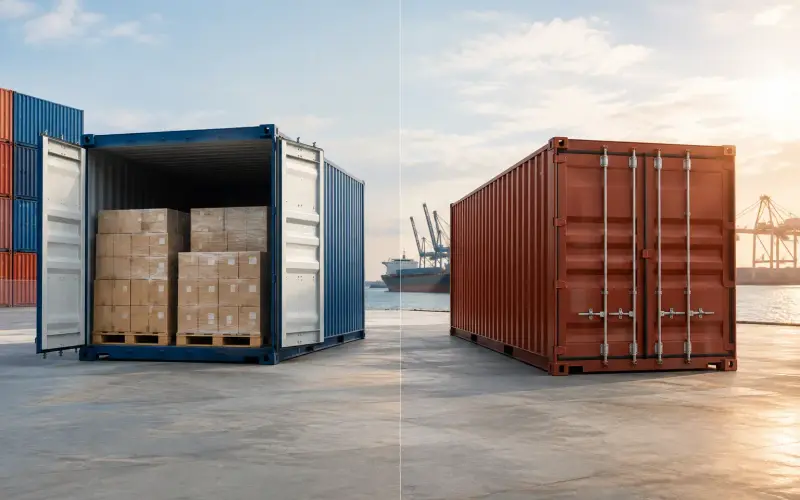
A move from Budapest to another continent can involve anything from a few boxes and a bicycle to the complete contents of a family home. That is why the shared container versus sole container decision matters so much. It affects not only the price, but also collection dates, transit times, handling, customs planning and the level of control you have over your shipment.
For most international sea freight moves, the choice comes down to sharing space in a container with other customers or booking an entire container for your own goods. Neither option is automatically better. The right choice depends on the volume you are sending, your delivery deadline, your destination and how much flexibility you can allow.
What is a shared container?
A shared container, often called LCL shipping or groupage, means your belongings travel in the same sea container as cargo from other customers. LCL stands for Less than Container Load. Each shipment is professionally packed, labelled and documented separately before being consolidated at a freight warehouse.
This is usually a practical option for students, expats and smaller households moving overseas with a limited quantity of furniture, personal belongings or cartons. Rather than paying for unused container space, you pay for the volume your shipment occupies, usually measured in cubic metres.
A shared container does not mean your belongings are packed loosely with someone else’s. A reputable freight forwarder keeps consignments identified and secured throughout the consolidation process. However, it does mean there are extra handling stages: your goods are collected or delivered to a warehouse, loaded into a shared container, unloaded at the destination warehouse and then prepared for final delivery.
What is a sole container?
A sole container is an entire sea freight container reserved for one customer. In shipping terms, this is generally known as FCL, meaning Full Container Load. Common sizes are 20-foot and 40-foot containers, although availability and suitable equipment can vary by route and cargo requirements.
This option suits larger household relocations, office moves, commercial cargo and shipments with enough volume to make exclusive use worthwhile. The container can often be loaded at your address, provided there is safe access and sufficient space for the vehicle and container handling. It is then sealed and normally remains sealed until it reaches the destination port or final customs-controlled location.
Having a sole container does not remove customs requirements, port procedures or possible inspections. It does, however, reduce the number of handling points and gives you more control over loading, especially when you have fragile, high-value or unusually shaped items.
Shared container versus sole container: the key differences
The most visible difference is pricing, but a low headline price should not be the only deciding factor. Sea freight costs are built from several elements, including collection, packing, export documentation, port charges, customs clearance, destination handling and delivery. These charges can apply differently to LCL and FCL shipments.
| Factor | Shared container / LCL | Sole container / FCL | |—|—|—| | Best for | Smaller moves and lower cargo volumes | Full household moves, offices and larger shipments | | Main cost basis | Volume occupied, often per cubic metre | Container size and route | | Transit planning | May wait for consolidation and deconsolidation | Often more direct once the container is loaded | | Handling | More warehouse handling at both ends | Usually fewer handling stages | | Loading control | Managed through a consolidation warehouse | Greater control over how your items are loaded | | Flexibility | Useful when you do not need a full container | Useful when you have enough goods to fill much of one |
Cost: volume is only part of the calculation
A shared container is commonly more economical when you are sending a modest amount of household goods. If you are moving from a furnished flat in Budapest and only taking personal effects, books, clothing, several cartons and a few pieces of furniture, LCL can prevent you from paying for empty space.
As the shipment grows, the calculation changes. LCL charges are based on volume and can include warehouse handling at both origin and destination. Once your goods approach a substantial share of a 20-foot container, a sole container may offer better value overall. This is why an accurate survey or detailed inventory is more useful than estimating from the number of rooms in your home.
Ask for a quote that clearly separates freight, collection, packing, customs support, destination charges and final delivery. Transparent pricing makes it easier to compare options fairly and avoids surprises after the shipment has departed.
Timing: a shared shipment can require more patience
For a shared container to depart, cargo from several customers must be consolidated. At the destination, each consignment must be separated before onward delivery. These additional steps can add time compared with a sole container travelling on the same sailing.
That said, sailing schedules, port congestion, transhipment routes, customs clearance and destination delivery availability can affect both options. A sole container is not a guaranteed express service. If a fixed move-in date matters, discuss the full door-to-door timeline rather than focusing only on the vessel’s estimated sea transit.
For urgent items, air freight or international box shipping may be more suitable than sea freight. Many customers send essentials such as documents, seasonal clothes and work equipment separately, then use sea freight for the bulk of their household goods.
Security and condition: packing still matters most
A sealed sole container offers a clear chain of custody and fewer handling stages, which can be reassuring for families and businesses. It may be particularly suitable for delicate furniture, machinery or a large volume of carefully packed goods.
However, a shared container can also be a safe choice when professionally prepared. The quality of export packing, internal protection, moisture control, labelling and loading is often more important than the container type alone. Sea journeys involve movement, humidity changes and handling at ports, so cartons designed for domestic removal are not always adequate for an international move.
Professional packers can wrap furniture, build protective crates where required and use appropriate materials for long-distance transport. They can also advise on items that may be restricted or unsuitable for sea freight, including hazardous materials, certain batteries, perishables and goods subject to import controls.
How to choose the right container for your move
Start with the actual volume of your shipment. A video survey, home visit or itemised inventory allows a freight specialist to estimate cubic metres more reliably. Be honest about items still in storage, garage contents and furniture you plan to take apart. Small omissions can make a meaningful difference to the recommended service.
Next, consider your destination. Door access, local customs rules and destination service charges can shape the best option. A container may be easy to position outside a house but impractical in a narrow city street, a building with limited loading space or an area with parking restrictions. In these cases, the shipment may need to be loaded or delivered through a warehouse arrangement.
Think about timing realistically. Choose shared shipping if your dates are flexible and cost efficiency is the priority. Consider a sole container if you are relocating a full home, coordinating an office opening, moving valuable equipment or need closer control over the loading process and schedule.
Finally, compare like for like. A quote for port-to-port freight is not equivalent to a door-to-door relocation service that includes packing, customs documents and delivery to your new home. Check what is included, what is excluded and who will support you if customs asks for additional information.
Customs and paperwork apply to both options
Whether you choose LCL or FCL, your shipment needs an accurate inventory and the correct supporting documents. Depending on the destination, this may include a passport copy, visa or residence permit, proof of address, proof of transfer of residence and declarations for personal effects. Some countries require documents before the vessel arrives, so late paperwork can cause storage charges and delays.
Do not pack important papers, medication, cash, jewellery or items you need immediately into sea freight. Keep them with you when travelling. It is also wise to check destination restrictions before packing rather than discovering a prohibited item during inspection.
BudaPack can help customers assess shipment volume, explain the practical differences between shared and sole containers, and prepare for the documentation process through its global logistics network. As a member of the International Association of Movers, BudaPack works to recognised professional standards for international relocation.
The best choice is the one that fits your goods, budget and deadline without leaving major details to chance. Request a tailored quote with your inventory and destination details, and you can make the container decision with a clear picture of the costs, process and delivery plan.
 Domestic Removals in Hungary Made SimplerRead more →
 Freight Rate Trends 2026 for Smarter ShippingRead more →
 Professional Packing Service Reviews That HelpRead more →