
A cracked screen, a crushed corner on a favourite picture frame, or one unlabelled box can make the first day in a new home far more stressful than it needs to be. The right packing supplies do more than fill boxes: they protect your belongings through lifting, stacking, road transport, storage and international transit, while making every item easier to find at the other end.
For a small move across Budapest, basic materials may be enough. For a family relocation abroad, student shipment, or commercial consignment, the packing plan needs more thought. Weight limits, handling points, transport mode and journey length all affect which materials are suitable.
Start with the journey, not the box
It is tempting to buy a large bundle of cartons and start packing immediately. A better approach is to consider what your goods will experience between collection and delivery. A box carried directly to a nearby flat has different requirements from one travelling through several freight depots, potentially spending time in a warehouse or shipping container.
International shipments can be loaded, unloaded and stacked alongside other consignments. This does not mean belongings will be handled carelessly, but it does mean each package should be able to support its own weight and offer proper protection to its contents. A poorly filled carton can collapse even when the outer cardboard looks strong.
Think about four practical questions before choosing materials: how fragile are the items, how heavy are they, how long will they travel, and will they be stored before delivery? Your answers determine whether standard cartons are appropriate or whether you need reinforced boxes, specialist wrapping or professional crating.
Essential packing supplies for most moves
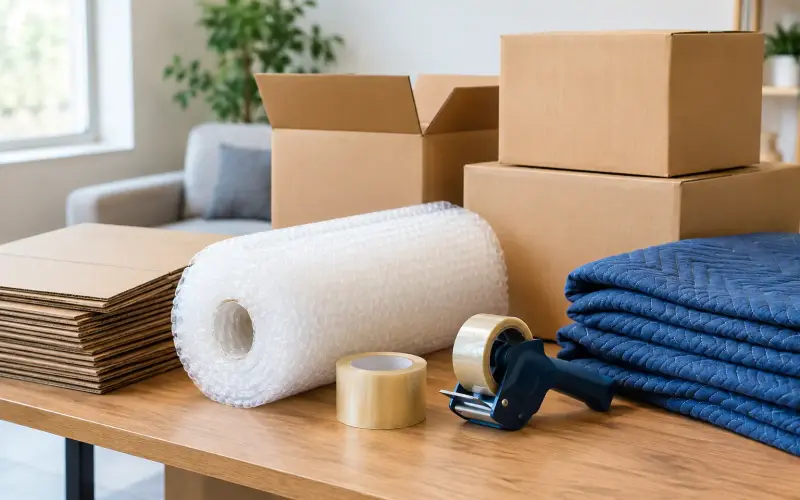
A well-prepared move does not require unnecessary materials. It requires the right materials in the right quantities. For most household moves, the following supplies cover the essentials:
- Double-wall cardboard boxes in several sizes
- Strong packing tape and a tape dispenser
- Bubble wrap or foam sheeting for fragile items
- Packing paper for wrapping and filling gaps
- Stretch film for securing drawers, furniture and grouped items
- Permanent markers and clear labels
- Mattress, sofa and furniture covers where needed
Cartons deserve particular attention. Small boxes are best for books, tools, canned food and other dense belongings. Large boxes suit lighter, bulky items such as bedding, coats and cushions. Filling a large carton with books may seem efficient, but it creates a box that is difficult to lift safely and more likely to fail at the base.
Packing paper is often more useful than people expect. It cushions plates, glassware and ornaments, but it also fills empty spaces inside a carton. Goods move when there is room for them to move. Once wrapped items are placed in the box, use crumpled paper around the sides and on top so the contents stay stable when the carton is lifted.
Why stronger boxes are worth it
Not all cardboard boxes are designed for relocation or shipping. Thin, single-wall cartons may be suitable for lightweight items moving a short distance, but they are rarely the best choice for long-distance transport, repeated handling or stacked storage.
Double-wall boxes provide greater resistance to crushing and punctures. They are especially useful for books, kitchenware, electronics, files and household items being sent internationally. If a box is reused, inspect it closely. Soft corners, old water damage, torn handles and weakened tape lines are signs that it should not carry anything valuable or heavy.
There is also a balance to strike. Oversized reinforced cartons can encourage overpacking, which creates lifting risks and may increase transport costs. Choose strength based on the contents, then keep each box at a manageable weight. For many people, this means combining a number of smaller, properly packed boxes rather than relying on a few very heavy ones.
Packing fragile and high-value belongings
Fragile items need layers of protection. Wrapping alone is not enough if an item can still knock against another object or against the side of the box. Each piece should be individually wrapped, placed upright where appropriate, and separated with cushioning material.
For plates, wrap each one separately and pack them vertically, rather than flat in a pile. Glasses should be individually wrapped, with extra protection around stems and rims. Avoid placing heavy objects above fragile ones, even if everything appears well padded. A clear label stating “Fragile” helps handlers identify the carton, but safe packing must do the real work.
Electronics should be packed in their original packaging where available. If it has been discarded, use a close-fitting box, anti-static protection where appropriate, and cushioning on all sides. Remove batteries from devices if recommended by the manufacturer, particularly for international shipping. Some battery types and goods containing batteries are subject to carrier restrictions, so confirm the requirements before packing.
Fine art, antiques, mirrors, large screens and sentimental items may need specialist materials or purpose-built crates. This is one area where saving money on supplies can be a false economy. Professional packing is often the safer choice when an item is difficult to replace, unusually shaped or particularly valuable.
Tape, labels and inventory: small details that prevent problems
Strong tape is a basic requirement, but how it is applied matters. Seal the centre seam and both edge seams at the base and top of each carton using the H-taping method. Do not rely on masking tape, string or a single strip of low-quality tape. These can loosen under weight, temperature changes or humidity.
Labelling is equally practical. Write the destination room, a short description of the contents and a box number on at least two sides of every carton. For example: “Kitchen – mugs and serving bowls – Box 12 of 34”. This makes unloading more organised and helps you identify priority boxes after delivery.
For an international move, create a separate packing inventory. Record the box number and a clear, general description of what is inside. An inventory supports customs documentation, insurance records and delivery checks. Avoid vague descriptions such as “personal items” when a more accurate description is possible. At the same time, do not list prohibited or restricted goods as ordinary household effects.
Furniture protection and awkward items
Furniture damage often happens at corners, edges and moving parts. Remove detachable legs, shelves and handles where practical, place fittings in a labelled bag, and secure that bag to the relevant item or keep it in a clearly marked essentials box. Wrap exposed corners with protective material before applying furniture blankets or stretch film.
Stretch film is useful for keeping drawers and doors closed, but it should not be placed directly on delicate polished surfaces for a long period, particularly in warm conditions. Use a protective layer first. Mattresses and upholstered furniture benefit from fitted covers that guard against dust, moisture and marks during transport or storage.
Heavy items such as safes, machinery and commercial equipment require more than additional bubble wrap. Their weight distribution, lifting points and securing method must be assessed properly. Specialist transport teams use suitable equipment and packing methods to protect both the goods and the people handling them.
Packing supplies for storage and international transport
Storage adds another consideration: time. Items may remain packed for weeks or months, so moisture, dust and pressure from stacking become more relevant. Use clean, dry boxes, avoid storing damp textiles, and keep liquids separate or avoid placing them in storage altogether where rules require it. Clearly mark cartons that should not be stacked.
For sea freight, protection against humidity and extended transit conditions can be particularly important. For air freight, dimensional weight may influence cost, making compact and efficient packing valuable. In both cases, packages must be secure without adding unnecessary bulk. The best option depends on the shipment, not on a one-size-fits-all materials list.
This is where experienced advice can prevent expensive mistakes. BudaPack combines local Budapest knowledge with a global logistics network and IAM membership standards to assess the right packing approach for household moves, business shipments and specialist items.
When professional packing makes sense
Packing your own belongings can be practical for a small, straightforward move, especially when you have time and access to quality materials. Professional packing is worth considering when you are relocating internationally, managing a family move while working, shipping fragile goods, or preparing an office or commercial consignment.
A professional team can bring suitable cartons and protective materials, pack efficiently, prepare an organised inventory and identify items needing extra care. It also reduces the last-minute pressure of trying to source supplies while you are arranging utilities, travel documents and handover dates.
Before buying packing supplies, estimate your move honestly and plan around the actual journey your belongings will take. If you are unsure which materials, box sizes or protection methods are right for your shipment, request a free quote and ask for tailored guidance. A carefully packed box is a simple thing, but it is one of the most reliable ways to begin a move with confidence.
 Domestic Removals in Hungary Made SimplerRead more →
 Freight Rate Trends 2026 for Smarter ShippingRead more →
 Professional Packing Service Reviews That HelpRead more →