
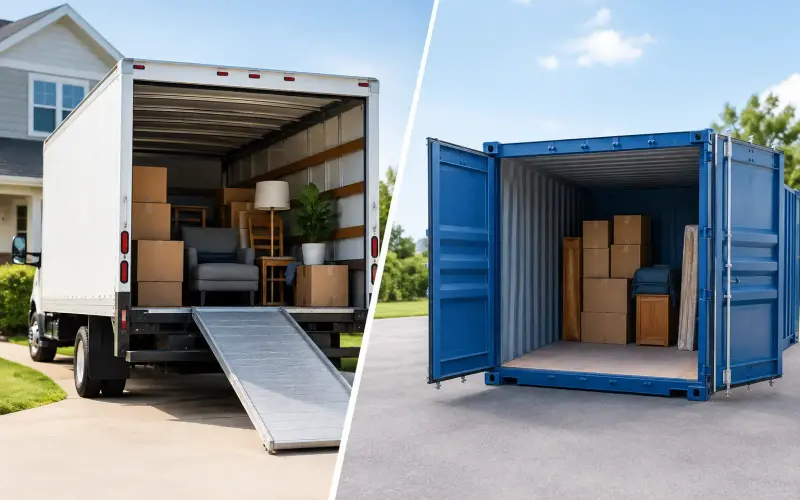
A moving van or container can both take your belongings from Budapest to another country, but they solve very different problems. The best choice depends less on the destination alone and more on how much you are moving, how quickly you need it, whether you need flexibility at either end, and how comfortable you are managing the loading process.
For an international student sending a few boxes, neither may be necessary. For a family relocating an entire household, the decision can affect cost, delivery time and the condition of your possessions on arrival. Understanding the differences before requesting quotes makes it much easier to compare services fairly.
What is the difference between a moving van and a container?
A moving van is normally a vehicle and crew dedicated to collecting, transporting and delivering your goods by road. It is often the practical choice for moves within Hungary or across Europe, especially when door-to-door timing matters. Your belongings are loaded at your home, secured in the vehicle and delivered directly to the new address or a storage facility.
A shipping container is a large steel unit used mainly for sea freight. It can be used as a full container load, where your household goods occupy the whole unit, or as part of a shared container service, where your shipment travels with goods from other customers. Containers are common for long-distance moves from Hungary to destinations outside Europe, including North America, Asia, Africa and Australia.
The terms can overlap in everyday conversation, but the transport method is not interchangeable. A van usually provides a direct road journey. A container usually involves collection, export handling, port transport, sea transit, customs clearance and final delivery.
Moving van or container: the key factors to compare
The right option is rarely simply the cheapest one. A lower initial price may leave out packing, loading, customs paperwork, terminal charges or delivery at destination. Ask what is included from the start.
| Factor | Moving van | Shipping container | |—|—|—| | Best suited to | Hungary and European road moves | Intercontinental household moves | | Transit time | Usually days, depending on route | Usually weeks, depending on sailing schedules | | Collection and delivery | Often direct door-to-door | May involve ports, depots and local delivery partners | | Volume | Small to large moves | Best value for larger shipments | | Flexibility | Strong for collection and delivery dates | More dependent on vessel schedules | | Customs | Often simpler within the EU | Usually required for international sea freight |
Volume and the amount you are moving
Start with a realistic inventory. A furnished one-bedroom flat may fit in a small dedicated vehicle, while a three-bedroom family home may need a larger lorry or a full container. Volume matters because road moving is commonly priced by vehicle space, route and labour, while sea freight is strongly influenced by container size, port charges and destination handling.
A full container can offer good value when you are moving substantial furniture, appliances and personal effects. However, it is not automatically the better choice for every overseas move. If you are taking only 10 to 20 boxes, a shared container service may be more sensible, although it usually takes longer because the shipment must be consolidated with others.
Avoid estimating from the number of rooms alone. A minimally furnished two-bedroom flat and a heavily furnished two-bedroom flat can have very different volumes. A detailed list, photographs or a video survey will help a moving company provide a more accurate quotation.
Destination and transit time
For relocations within the European Union, a moving van is often the simplest route. It can collect from Budapest and travel directly to cities such as Vienna, Berlin, Amsterdam, Paris or London, subject to route planning and border requirements. You have more control over collection and delivery windows, and there is no need to wait for a vessel departure.
For moves beyond Europe, sea freight containers are usually the practical option for a full household. They cost considerably less than air freight for large volumes, but patience is required. Port congestion, transhipment, weather and customs processing can all affect schedules.
If you need essential items quickly, consider separating them from the main shipment. Important documents, medication, work equipment, a few clothes and children’s necessities can travel with you or be sent by express courier, while furniture and non-essential belongings move by road or sea.
Access at each address
A container needs suitable access if it is to be delivered and loaded outside your property. Narrow Budapest streets, parking restrictions, low bridges, steep driveways and limited loading space can make this difficult. The same issue can arise at the destination.
A moving van may be easier to position, but access still affects the job. A top-floor flat without a lift, a long walk from the vehicle or restricted city-centre parking can increase loading time. In some cases, a smaller shuttle vehicle or external lift is needed. Mention access limitations early so the quote reflects the real work involved.
Packing, protection and liability
A road move and a sea container both require careful packing, but sea freight places different demands on household goods. Long journeys, handling at terminals and changing humidity levels mean furniture needs proper wrapping, cartons need to be strong, and the load must be professionally secured to prevent movement.
Self-packing can reduce upfront costs, but it also transfers more responsibility to you. Poorly packed boxes may be more vulnerable to damage, and customs authorities may need a clear packing list. Professional packing is particularly valuable for fragile items, artwork, electronics, mirrors and furniture travelling overseas.
Ask about transit protection or insurance options and read the terms carefully. The declared value of your goods, exclusions and claims procedure all matter. Do not assume that standard carrier liability covers the full replacement cost of a household shipment.
Customs can change the answer
Customs is one of the biggest differences between an EU road move and an international container shipment. Personal belongings entering a new country may qualify for relief from import duties and taxes when they are part of a genuine change of residence, but the rules vary by destination.
You may be asked for a passport copy, visa or residence permit, proof of address, a signed inventory and evidence that the goods have been owned and used. Some countries restrict food, plants, alcohol, wooden items, batteries, medicines or particular animal products. Never pack prohibited items simply because they were acceptable in Hungary.
A reliable mover or freight forwarder can explain the documentation needed, but customers should still provide accurate information. An incomplete inventory or an incorrect declared value can lead to delays, inspections and unexpected charges.
When a moving van is the better choice
Choose a moving van when your new home is in Hungary or another reachable European destination, you want a relatively fast door-to-door service, and you value control over the collection and delivery schedule. It is also a sensible option for partial moves, student relocations with several boxes and furniture, or temporary moves where storing goods at a port would be impractical.
A dedicated vehicle generally gives your shipment less handling than a shared service. That can be reassuring for valuable household goods, although a shared van may be more economical when your move is small and your dates are flexible.
When a container is the better choice
A container is usually the stronger option when moving a complete home overseas and time is less critical than overall cost. It is particularly suitable for families shipping furniture, household equipment and personal possessions to a destination where road transport is not possible.
A full container also provides a clear, dedicated space for your goods. For smaller shipments, shared container freight can reduce the cost, but transit times and collection dates are less predictable. Plan around a delivery range rather than a single guaranteed date.
Get a quote that you can actually compare
When comparing a moving van or container quote, provide the same information to each provider: collection and delivery addresses, access details, a rough inventory, preferred dates, packing requirements, storage needs and any goods requiring special care. Then check whether the quote includes collection, packing materials, loading, export documents, transport, customs support, port charges, destination handling and final delivery.
BudaPack can assess these details and recommend a route suited to your move, backed by an international logistics network and International Association of Movers membership. The aim is not to push one transport method, but to give you a realistic plan, clear costs and appropriate support at every stage.
Before committing, ask what could change the price or timing. A transparent answer now is far better than a surprise once your belongings are already in transit. Request a tailored quote with your inventory and destination details, and choose the option that gives you the right balance of speed, care and cost.
 Domestic Removals in Hungary Made SimplerRead more →
 Freight Rate Trends 2026 for Smarter ShippingRead more →
 Professional Packing Service Reviews That HelpRead more →