
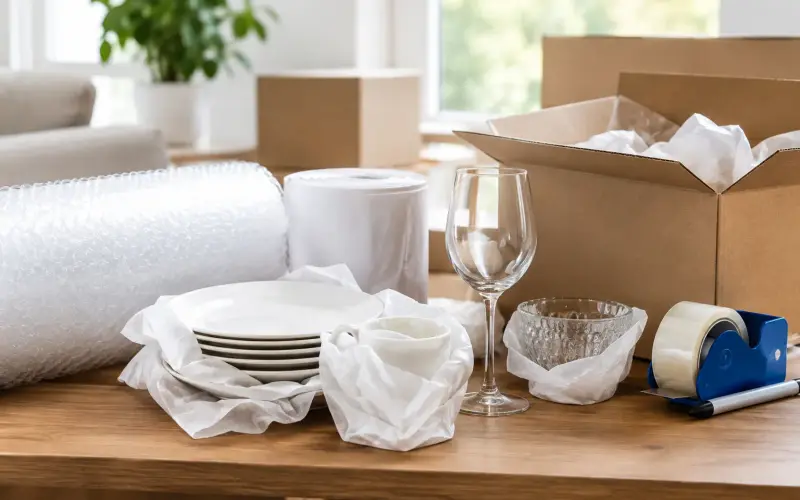
A wine glass rarely breaks because it was simply placed in a box. It breaks because the box was too large, the empty space was not filled, or the package was handled without enough protection for the journey ahead. Choosing the best supplies for fragile items is therefore less about buying the most material and more about combining the right materials in the right order.
This matters whether you are moving between flats in Budapest, sending a parcel to a family member abroad, or preparing a full international relocation. A box carried across town faces some risk. One travelling through several depots, vehicles and customs checks needs a much higher level of protection.
Start with the journey, not the item
Before packing, consider how far the item will travel and how it will be transported. A framed picture travelling in your own car may need corner protectors and a padded cover. The same picture sent by road freight or air freight should be placed in a purpose-built carton, immobilised with cushioning, and clearly labelled.
Weight is equally important. Heavy fragile items, such as ceramics, books with delicate bindings, or small appliances with glass components, should go into smaller cartons. A large box may appear efficient, but it becomes difficult to lift safely and allows heavy contents to shift. Keep cartons manageable and avoid packing fragile goods with dense, loose items that could crush them.
Moisture, temperature changes and long storage periods can also affect the choice of materials. Paper-based protection is often suitable for a short domestic move, while international shipping may call for stronger outer cartons, sealed wrapping and extra internal protection.
Best supplies for fragile items: the essential kit
A reliable packing kit does not need to be complicated. Each supply has a specific role: contain the item, cushion impacts, prevent movement, and keep the carton closed throughout handling.
- Double-walled cardboard cartons provide stronger protection than thin, single-wall boxes and are a sensible choice for glassware, electronics, kitchenware and artwork.
- Packing paper is clean, flexible and ideal for wrapping plates, bowls, glasses and ornaments. Use unprinted paper where possible, especially for light-coloured or delicate surfaces.
- Bubble wrap protects vulnerable surfaces and irregular shapes. Larger bubbles offer better shock absorption, while smaller bubbles work well for lighter, detailed objects.
- Foam sheets and foam corners are useful for mirrors, framed artwork, screens and polished furniture parts that could be scratched by other packing materials.
- Void fill, such as crumpled kraft paper, air cushions or foam peanuts, stops contents moving inside the carton. It is not a substitute for wrapping each item individually.
- Quality packing tape should be wide, pressure-sensitive and suitable for the carton weight. Weak tape is a common cause of boxes opening during transit.
It is tempting to reuse supermarket cartons or old delivery boxes. Reuse is often fine for lightweight, non-breakable household goods if the box is dry, clean and structurally sound. For fragile items, especially those travelling internationally, new double-walled cartons are the safer investment. Previous folds, punctures and water exposure can significantly reduce a box’s strength.
Packing paper versus bubble wrap
Packing paper and bubble wrap work best together rather than as alternatives. Wrap glass, china and ceramics first with paper to protect the surface, then add bubble wrap around particularly vulnerable pieces. Paper also fills small gaps between items and is easier to shape around stems, handles and curved surfaces.
Bubble wrap alone can leave items loose if it is not secured properly. Wrap it with the bubbles facing inward for many delicate objects, tape it lightly so it does not unravel, and avoid applying adhesive directly to finished surfaces. For silver, lacquered items or sensitive artwork, use acid-free tissue paper as the first layer.
The carton matters as much as the cushioning
A well-wrapped item can still be damaged in an oversized carton. Choose a box that leaves enough room for a cushioned base, protection around all sides, and a final layer of void fill on top. As a general rule, fragile contents should not touch the carton walls.
Build a base of crumpled paper or foam before placing anything inside. Pack the heaviest pieces at the bottom and lighter pieces above them, but do not stack heavy items directly on delicate ones. Fill every remaining gap until nothing moves when you gently shake the sealed carton.
Supplies for common fragile household items
Different objects fail in different ways, so they require slightly different packing methods.
Glassware, plates and ceramics
Wrap every piece separately. For plates, place a sheet of packing paper between each one, wrap small stacks securely, and pack them vertically on their edge rather than flat. This reduces pressure across their broadest surface. Glasses should be filled lightly with paper, wrapped individually, and placed upright in a compartmentalised carton where possible.
Bottle dividers are useful for sets of glasses, but they do not remove the need for wrapping. A divider stops side-to-side contact; paper and cushioning protect against vibration and impact.
Mirrors, pictures and framed art
Apply foam corners first, then cover the front and back with foam sheets or cardboard panels. Wrap the piece in bubble wrap and place it in a mirror or picture carton that closely matches its dimensions. For valuable, antique or especially large artwork, a custom wooden crate may be appropriate, particularly for international transport.
Do not use ordinary tape directly on glass, painted frames or canvas. If glass breaks, tape can complicate safe handling and may damage the surface during removal.
Electronics and screens
Whenever available, the original manufacturer packaging is usually the best option for televisions, monitors and small electronics. It was designed for that product’s shape and weight. If it is no longer available, use a sturdy double-walled carton, anti-static material where appropriate, foam protection around corners, and enough void fill to prevent movement.
Remove batteries where practical, secure loose cables separately, and photograph the condition of valuable electronics before packing. For international shipments, check destination restrictions for lithium batteries before the goods are collected.
Lamps, ornaments and awkward shapes
Remove detachable parts such as lampshades, bulbs and finials. Wrap each component separately, then use bubble wrap and shaped void fill to support the item in a correctly sized carton. Avoid forcing irregular objects into boxes that are too small, as pressure points can cause cracks before the carton even leaves your home.
Seal, label and handle cartons properly
Use the H-taping method on the top and bottom of each carton: one strip along the centre seam and one along each edge seam. This distributes the load better than a single strip of tape. Reinforce heavy cartons, but do not wrap excessive tape around the entire box, as it can make inspections and careful opening harder.
Mark cartons clearly with their contents, destination room and handling instructions such as “Fragile” or “This Way Up”. These labels are helpful, but they are not protective packaging. Pack every carton as though it could be tilted or stacked during transport, because it may be.
For a move, keep high-value documents, jewellery, medication and irreplaceable personal items with you where possible. Professional movers can pack and transport many fragile belongings safely, but some items are best kept under your direct control.
When professional packing is the better choice
Professional packing is particularly worthwhile for fine art, antiques, chandeliers, large mirrors, specialist equipment and items with high financial or sentimental value. The cost needs to be weighed against the risk: a custom crate and specialist materials may seem excessive for an ordinary vase, but they can be sensible for a fragile artwork crossing borders by air or sea freight.
An experienced team can assess the item, route, transport mode and customs requirements before choosing the packing method. BudaPack provides professional packing for domestic and international moves, supported by a global logistics network and its membership of the International Association of Movers (IAM).
If you are unsure whether a carton, crate or specialist packing method is right for your belongings, request a free quote and describe the item, its dimensions, value and destination. A tailored plan can prevent a small packing decision from becoming an expensive problem at delivery.
 Domestic Removals in Hungary Made SimplerRead more →
 Freight Rate Trends 2026 for Smarter ShippingRead more →
 Professional Packing Service Reviews That HelpRead more →